




Custom Canopy Tent Printing Guide: What You Need to Know

Custom printing is one of the most important parts of a custom canopy tent. The printing method affects color quality, design detail, durability, fabric compatibility, and the overall appearance of the finished tent.
For businesses, brands, event organizers, schools, teams, and other organizations, choosing the right printing process is especially important when a tent will be used outdoors, transported frequently, and set up and taken down repeatedly.
This guide explains the main printing methods used for custom canopy tents, how different fabrics affect printing, and what to consider when preparing artwork and selecting a printing method.
What Is Custom Canopy Tent Printing?
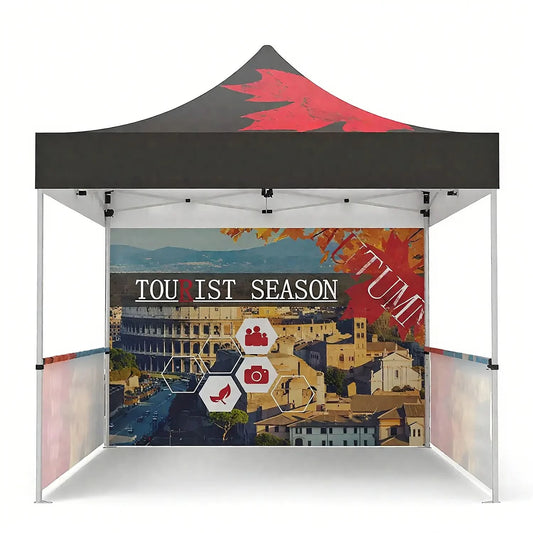
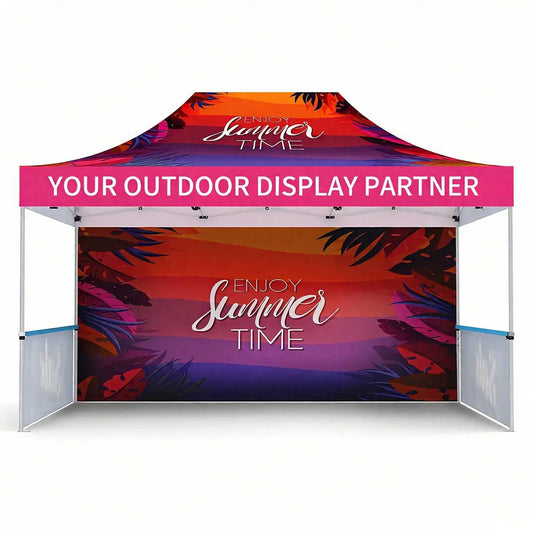
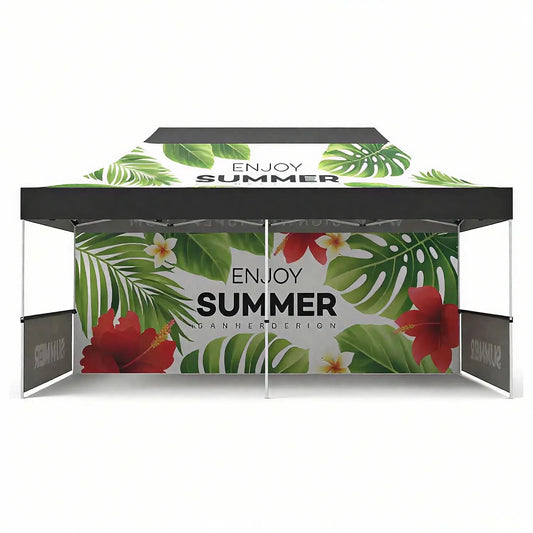
Custom canopy tent printing is the process of applying a logo, brand name, graphics, photographs, colors, or other artwork to the canopy roof, valance, and sidewalls.
Depending on the fabric, artwork, and production requirements, manufacturers may use different printing technologies.
The three main printing options discussed in this guide include:
- Dye sublimation printing: Well suited to full-color graphics, photographs, gradients, and detailed custom designs.
- Screen printing: A proven option for simple logos, text, solid colors, and designs with a limited number of colors.
- Digital printing: A flexible option for detailed logos, complex artwork, and certain smaller production runs.
In this guide, digital printing refers to the alternative digital printing process offered alongside dye sublimation and screen printing. The right method depends on the fabric, artwork, order quantity, intended use, and required outdoor performance.
Main Printing Methods for Custom Canopy Tents
1. Dye Sublimation Printing
Dye sublimation is widely used for high-quality custom canopy graphics, particularly when the design contains multiple colors, gradients, detailed graphics, or photographs.
During the process, disperse dye is transferred into suitable polyester fabric using heat. When the fabric and coating are properly designed for sublimation, the color becomes integrated into the fabric rather than remaining as a conventional thick layer of surface ink.
Advantages of Dye Sublimation
- Excellent full-color reproduction
- Suitable for complex artwork and detailed graphics
- Smooth gradients and photographic images
- Good coverage over large printed areas
- No conventional heavy surface ink layer
- Well suited to graphics that need to be folded and transported repeatedly
Fabric Requirements
Dye sublimation requires suitable polyester fabric and a printing-compatible construction.
For example, 600D PU polyester Oxford can be used for dye sublimation when the specific fabric and coating are developed and tested for the process.
The fact that a fabric is polyester alone does not automatically mean it is suitable for every sublimation process. Fabric construction, coating, heat resistance, and the printing system all need to be compatible.
Traditional PVC-coated fabrics are generally not suitable for conventional dye sublimation. If a specific coated fabric is being considered, its printing compatibility should be confirmed with the manufacturer.
Outdoor Durability
Dye sublimation is a practical choice for reusable outdoor canopy tents because the dye becomes integrated into compatible polyester fibers rather than forming a conventional thick surface ink layer.
This reduces the risk of cracking or peeling associated with heavy surface-applied graphics during normal folding and handling. However, prolonged exposure to sunlight can still cause gradual color fading. Actual performance depends on the fabric, ink, production process, and outdoor conditions.
2. Screen Printing
Screen printing is an established printing method for custom canopy tents. It is especially useful for relatively simple designs with logos, text, solid colors, and a limited number of colors.
The process applies ink through prepared screens. Separate screens are generally required for different colors, making artwork preparation and production setup important considerations.
Advantages of Screen Printing
- Well suited to simple logos and text
- Good for solid colors and bold graphics
- Suitable for larger production quantities
- Can produce strong, opaque colors
- Practical when the design uses a limited number of spot colors
Screen printing can also reproduce basic gradients through halftone techniques. However, halftone printing uses dot patterns and generally does not produce the same smooth photographic appearance as dye sublimation.
Outdoor Durability
The outdoor durability of screen printing depends on the ink system, fabric, coating, curing process, and manufacturing quality.
A properly produced screen-printed canopy can perform well outdoors. However, large areas of heavy surface ink may be more susceptible to cracking or wear after prolonged repeated folding.
For this reason, the ink and fabric combination should be selected according to the intended use of the tent.
3. Digital Printing
Digital printing uses digital artwork files to reproduce graphics through a compatible digital printing system. It is another option for customizing canopy tents with logos, detailed artwork, and complex designs.
Unlike traditional screen printing, digital printing does not require a separate screen for each color. This can make it a practical option for certain smaller production runs, samples, and specialized printing requirements.
Advantages of Digital Printing
- Suitable for detailed logos and complex artwork
- Supports full-color graphic reproduction, depending on the printing system
- Does not require traditional color-specific screen preparation
- Can be practical for smaller production quantities
- Offers flexibility for certain customized designs
Fabric Compatibility and Outdoor Performance
Digital printing compatibility depends on the specific printer, ink system, fabric, coating, and any required pretreatment or finishing process.
Not every digital printing system is suitable for every polyester or coated fabric. The exact production method should be confirmed before selecting the material.
Outdoor performance also varies between printing systems. Factors such as sunlight exposure, ink adhesion, abrasion, curing, and repeated folding can affect the finished graphics.
For tents intended for frequent outdoor use, it is advisable to confirm the printing system's suitability and review a production sample before placing a larger order.
Dye Sublimation vs. Screen Printing vs. Digital Printing
Each printing method offers different advantages in graphic reproduction, fabric compatibility, production setup, and outdoor performance.
| Comparison | Dye Sublimation | Screen Printing | Digital Printing |
|---|---|---|---|
| Printing Principle | Disperse dyes are transferred into compatible polyester fibers using heat. | Ink is applied to the fabric surface through prepared screens. | Digital artwork is reproduced using a compatible digital printing system. |
| Graphic Capability | Full-color graphics, photographs, complex artwork, and gradients. | Simple logos, text, solid colors, and limited-color designs. | Detailed logos, complex graphics, and full-color designs, depending on the system. |
| Fabric Compatibility | Light-colored polyester fabrics designed for sublimation; traditional PVC coatings are generally unsuitable. | Various fabrics and coatings, depending on ink compatibility. | Depends on the specific printer, ink, fabric, coating, and pretreatment. |
| Ink Layer and Hand Feel | Dye penetrates compatible fibers without a conventional heavy surface ink layer. | Ink remains on the fabric surface; heavy ink coverage may change the fabric's feel. | Depends on the ink system and printing application method. |
| Outdoor Durability | Well suited to outdoor applications, although prolonged sunlight can gradually fade colors. | Depends on ink, fabric, curing, and manufacturing quality. | Depends on the specific ink, fabric, finishing process, and outdoor testing. |
| Repeated Folding | Well suited to repeated folding because there is no conventional heavy surface ink layer. | Heavy ink areas may experience cracking or wear after prolonged repeated folding. | Performance varies by printing system and should be evaluated for the intended application. |
| Minimum Order and Setup | No traditional color-specific screen setup; suitable for small to large production runs. | Requires screen preparation; generally more economical for larger quantities. | No traditional color-specific screen setup; can be practical for smaller runs. |
| Color Characteristics | Excellent full-color reproduction; brand color matching depends on fabric and color management. | Good spot-color control; additional colors require additional screens and setup. | Color reproduction depends on printer capability, ink, fabric, and color management. |
| Recommended Artwork | High-resolution images, vector logos, and detailed raster graphics prepared according to the supplier's color requirements. | AI, EPS, or vector-based PDF files for logos and text; halftone artwork requires appropriate preparation. | High-resolution raster images and compatible vector artwork. |
| Main Considerations | Fabric and coating must withstand the sublimation process. | Multi-color registration, screen setup, and heavy ink coverage require attention. | Fabric compatibility and outdoor performance should be confirmed for the specific printing system. |
| Best Applications | Full-color branding, photographs, gradients, and reusable promotional tents. | Simple logos, text, limited spot colors, and larger production runs. | Detailed custom graphics, samples, smaller batches, and specialized requirements. |
Printing performance can vary according to the actual fabric construction, coating, ink system, equipment, and production process. Sample testing is recommended when compatibility or outdoor durability is a key requirement.
How Fabric Affects Custom Canopy Tent Printing
The fabric and printing process should always be considered together. Different coatings can affect heat resistance, ink adhesion, color reproduction, and the final appearance of the printed canopy.
600D PU Polyester Oxford
600D PU polyester Oxford is a common choice for custom canopy tents, particularly when detailed full-color graphics are required.
When the specific fabric and coating are designed for sublimation, it can support high-quality dye sublimation printing while providing the flexibility and construction needed for repeated outdoor use.
It is particularly suitable for:
- Full-color branding
- Detailed logos
- Complex graphics
- Photographic images
- Frequent setup and takedown
- Promotional and commercial events
600D PVC Polyester Oxford
600D PVC-coated polyester can provide good durability and water resistance, but its printing compatibility differs from PU-coated polyester.
Traditional PVC-coated fabrics are generally not suitable for conventional dye sublimation. Screen printing or a compatible digital printing process may be more appropriate, depending on the fabric construction and ink system.
The specific fabric and printing combination should always be confirmed before production.
420D Silver-Coated Polyester Oxford
420D silver-coated polyester is another option for applications where lighter weight and additional sun protection are priorities.
However, its printing performance depends on the specific construction and coating. Not every silver-coated fabric is suitable for the same printing processes.
For highly detailed full-color branding, select a printing-compatible polyester fabric and confirm the result with a sample when necessary.
For a more detailed comparison of fabric construction, coatings, and durability, see our Custom Canopy Tent Fabric Guide.
What Can You Print on a Custom Canopy Tent?
Almost any visual element used for branding or promotion can be incorporated into a custom canopy design, subject to artwork and printing requirements.
Common examples include:
- Company logos
- Brand names
- Product images
- Slogans and promotional messages
- Contact information
- Website addresses
- Social media handles
- Event graphics
- Team logos
- Sponsor logos
- Custom patterns and backgrounds
The canopy roof and sidewalls can be designed as one coordinated visual system rather than treating each panel separately.
For more specific advice on logo size, placement, and visibility, see our Custom Canopy Tent Logo Placement Guide.
Printing the Canopy Roof, Valance, and Sidewalls
A custom canopy tent provides several different areas for branding. Each area has a different viewing angle and serves a different purpose.
Canopy Roof
The roof is often the most visible part of a custom canopy tent, especially at outdoor events and large venues. It can accommodate large logos, brand graphics, and designs intended to be recognized from a distance.
Valance
The valance is the fabric section along the lower edge of the canopy roof. It is suitable for shorter information such as company names, website addresses, phone numbers, and taglines.
Sidewalls
Sidewalls provide additional vertical printing space for large logos, product images, promotional messages, and detailed brand graphics.
Depending on the design and event requirements, customers can choose:
- No sidewalls
- One back wall
- One back wall plus two half walls
- Three full walls
- Four full walls with a zipper door
For a more detailed comparison of wall configurations, see our Custom Canopy Tent Sidewall Options Guide.
Single-Sided vs. Double-Sided Printing
Single-sided printing is suitable for most applications where the primary viewing direction is known.
It can be a practical choice when:
- The main audience is on one side of the tent
- The back of the graphic does not need to match the front
- Keeping the construction lighter is important
- Production cost needs to be controlled
Double-sided construction can be considered when a sidewall will be viewed from both sides or when different graphics are needed on opposite surfaces.
It can provide:
- Better visibility from multiple directions
- Different graphics on opposite sides
- A more finished appearance
- Greater branding flexibility
For some double-sided printed sidewalls, two separately printed fabric layers may be joined together to display different graphics on each side. The exact construction should be confirmed with the manufacturer before production.
Double-sided construction generally requires additional material and manufacturing work, so it can increase overall cost and weight.
How to Choose the Right Printing Method
Start with your design and intended use rather than choosing the printing process first.
Choose Dye Sublimation When:
- You need full-color graphics
- Your design contains gradients
- You want photographic-quality images
- Your artwork is complex
- Large areas need detailed graphics
- The tent will be folded and transported frequently
- You are using compatible polyester fabric
Choose Screen Printing When:
- The design contains a simple logo
- You only need a few colors
- The artwork uses solid colors
- You are ordering a larger quantity
- Full photographic reproduction is not necessary
Consider Digital Printing When:
- You need detailed logos or complex artwork
- Your project requires a flexible digital printing process
- You are ordering a sample or smaller production quantity
- Your selected fabric is compatible with the printing system
- The expected outdoor performance has been confirmed
For long-term outdoor use, confirm the actual ink system, fabric compatibility, and durability before selecting a digital printing option.
Artwork Requirements for Custom Canopy Printing
Good artwork is essential for achieving a professional result. The file format, image resolution, color setup, and final print dimensions can all affect the finished graphics.
Vector Artwork
Vector files are preferred for:
- Logos
- Text
- Icons
- Simple illustrations
Common vector formats include AI, EPS, SVG, and vector-based PDF. Vector artwork can be scaled without losing sharpness, making it particularly useful for large canopy graphics.
Raster Artwork
High-resolution raster images can be used for:
- Photographs
- Detailed illustrations
- Complex graphics
Artwork should be supplied at an appropriate resolution for the final printed size. Approximately 150–300 PPI at final size may be suitable for highly detailed graphics, while lower resolutions may be acceptable for large graphics viewed from a distance. The exact requirement depends on the artwork, viewing distance, and printing system.
Color Requirements
CMYK artwork is commonly used for full-color print production, although the preferred file color space depends on the manufacturer's printing workflow. Screen printing may instead use separate spot-color specifications depending on the design.
Brand colors should be checked carefully because the appearance of a color on a computer screen may differ from the final printed fabric.
For important brand colors, providing Pantone references or existing brand guidelines can help improve color consistency. A production proof or sample is useful when accurate color matching is important.
For more information about file formats, image resolution, and artwork preparation, see our Custom Canopy Tent Artwork Preparation Guide.
What Affects Custom Canopy Printing Cost?
Printing cost depends on more than the number of colors. The printing method, fabric, printed area, artwork, and order quantity can all affect the final production cost.
Important factors include:
- Printing method
- Fabric type and coating
- Total printed area
- Number of canopy and sidewall panels
- Number of colors
- Artwork complexity
- Single-sided or double-sided construction
- Quantity ordered
- Special finishing requirements
For large full-color canopy graphics, dye sublimation can be efficient because the entire design can be reproduced without preparing separate screens for each color.
For simple logos with limited colors, screen printing may be more economical for larger quantities because setup costs can be spread across more units.
Digital printing can be practical for smaller production runs, depending on the equipment, fabric, and production requirements.
Common Custom Canopy Printing Mistakes
Choosing the Printing Method Before Choosing the Fabric
The fabric and printing process must be compatible. Do not assume that every polyester or coated fabric can use the same printing method.
Using Low-Resolution Artwork
Low-resolution images may appear acceptable on a computer screen but become soft or pixelated when enlarged for a canopy.
Whenever possible, provide vector artwork for logos and high-resolution files for photographs.
Designing Only for the Roof
A canopy tent is viewed from multiple directions. A strong design should consider:
- Roof visibility
- Front-facing graphics
- Sidewall graphics
- Valance branding
- Logo placement
- Reading distance
- Event environment
Ignoring Repeated Folding
Custom canopy tents are often folded, transported, and installed repeatedly.
The printing process should therefore be evaluated not only for its initial appearance but also for how the graphics are expected to perform during normal use and storage.
Skipping Artwork and Color Approval
Do not assume that the final printed result will look exactly like the design displayed on a computer screen.
Review the artwork layout, colors, panel placement, and final mockup before production. If accurate color reproduction or printing performance is particularly important, request an appropriate sample or production proof.
Custom Canopy Printing for Different Applications
Different users may have different graphic requirements depending on their event, audience, and branding goals.
Trade Shows and Exhibitions
Trade show tents often require detailed branding, logos, product graphics, and strong visual consistency.
Dye sublimation works particularly well for these applications when the fabric is compatible, especially when the design includes full-color graphics and detailed images.
Outdoor Events
Event organizers may need large logos, sponsor graphics, event names, and promotional messaging.
The graphics should be designed for visibility from multiple directions, particularly when the tent is positioned in a busy outdoor venue.
Sports Teams and Schools
Sports tents often use team colors, logos, mascots, and sponsor information.
Screen printing can work well for simpler designs, while dye sublimation provides greater flexibility for complex full-color graphics.
Businesses and Brands
Businesses can use custom canopy tents as portable brand displays at:
- Outdoor promotions
- Product launches
- Markets
- Festivals
- Community events
- Corporate events
- Brand activations
A well-designed custom canopy can function as both shelter and a large-format marketing display.
Frequently Asked Questions
Which Printing Method Is Best for Custom Canopy Tents?
Dye sublimation is generally the best choice for full-color graphics, complex artwork, and frequently used custom canopy tents made with compatible polyester fabric. Screen printing is more suitable for simple logos and larger production runs, while digital printing can be considered for smaller batches and specialized requirements.
Can 600D PU Polyester Oxford Be Dye Sublimation Printed?
Yes. Pyrasun's sublimation-compatible 600D PU polyester Oxford is our recommended fabric for detailed, full-color custom canopy graphics. However, not all PU-coated polyester fabrics are automatically suitable for sublimation. The fabric construction, coating, and heat resistance must be compatible with the printing process.
Can Canopy Tent Sidewalls Be Printed on Both Sides?
Yes. Double-sided sidewalls can display the same or different graphics on each side. Compared with single-sided printing, double-sided construction generally requires additional fabric and manufacturing work, resulting in higher costs and weight.
What Artwork File Format Is Best for Custom Canopy Tent Printing?
Vector files such as AI, EPS, and vector-based PDF are preferred for logos and text because they can be enlarged without losing sharpness. High-resolution raster images are suitable for photographs and complex graphics. Resolution requirements depend on the final print size and printing process.
How Long Does Custom Canopy Tent Printing Last Outdoors?
There is no universal lifespan for custom canopy printing. Durability depends on the printing method, fabric quality, ink system, UV exposure, usage frequency, and maintenance. Dye sublimation is particularly suitable for repeated folding because it does not create a conventional heavy surface ink layer, although prolonged sunlight exposure can still cause gradual fading.
Final Thoughts
A successful custom canopy printing project comes down to matching the fabric, printing process, artwork, and intended use.
Dye sublimation is a strong option for detailed full-color graphics on compatible polyester fabrics. Screen printing is practical for simpler designs with a limited number of colors, particularly for larger production quantities. Digital printing offers another flexible option for detailed graphics and certain smaller production runs, provided the printing system is compatible with the selected fabric and intended application.
Choosing the right combination helps ensure that your custom canopy tent delivers the appearance, functionality, and printing performance needed for your business and outdoor events.
Get a Free Custom Canopy Tent Design & Quote
Share your logo and project details. Get a free 3D design preview and a personalized quote for your branded canopy tent.