




Custom Canopy Tent Sidewall Options: How to Choose the Right Configuration

Custom canopy tent sidewalls are available in different configurations, and each option serves a different purpose. Custom canopy tents can be set up with a single backwall, half-walls, full walls, or other custom sidewall options depending on the needs of your event. Some businesses mainly need a large branded backdrop, while others need to hide equipment, improve privacy, reduce side sunlight, or create a more enclosed event space.
The right sidewall configuration depends on how you use the tent, where it will be used, and how you want customers to move through the space. This guide compares the most common sidewall configurations and special options, including backwalls, half-walls, full walls, mesh, clear PVC, and double-sided printed sidewalls, so you can choose the setup that best fits your event requirements.
If you are still deciding whether sidewalls are necessary for your business, start with our guide to the benefits and uses of custom canopy tents with sidewalls.
1 Backwall: An Open Setup With a Branded Backdrop
What Is a Single Backwall?
A single backwall configuration uses one full-height sidewall across the back of the canopy while leaving the front and both sides completely open.
This is one of the simplest sidewall setups because it adds a large vertical branding area without enclosing the tent.
Why Choose a Single Backwall?
A single backwall is a practical choice when your main goal is branding while keeping the tent open and accessible.
- Reduces rear sunlight and wind: The backwall can provide additional coverage from sunlight and wind coming from behind the tent.
- Creates a primary branding area: A large logo, company name, or promotional graphic can be displayed on the back of the tent.
- Adds printing space at a lower cost: You can increase your branded surface area without paying for multiple printed walls.
- Maintains good airflow: With three sides open, air can move relatively freely through the canopy.
- Keeps access open: Customers and staff can approach the tent from multiple directions.
Best For
A single backwall works particularly well for outdoor promotions, street markets, sports event booths, brand activations, and other events where an open layout is important.
When a Single Backwall May Not Be Enough
A backwall provides limited privacy because the sides remain open. It also provides little protection from sunlight or rain entering from either side.
If you need to hide inventory, equipment, or staff areas, or if you need more coverage from side-angle sunlight and light rain, a configuration with additional sidewalls may be more appropriate.
1 Backwall + 2 Half-Walls: A Balanced Setup
What Is a Backwall + 2 Half-Wall Configuration?
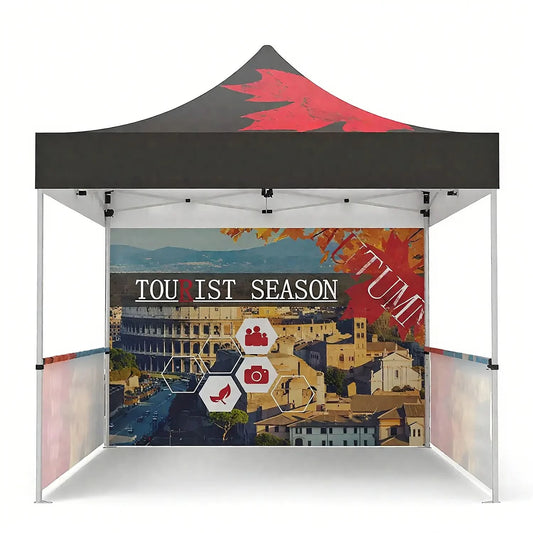
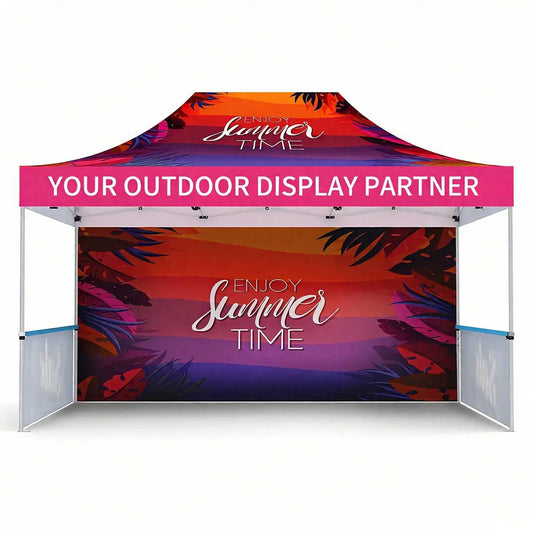
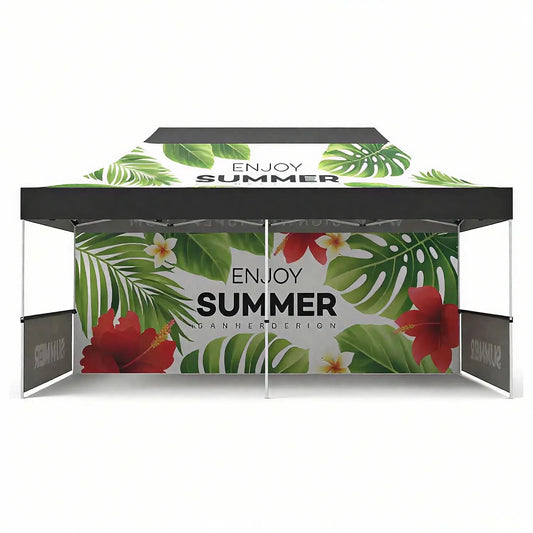
This configuration combines one full-height backwall with two half-height sidewalls. The back is completely covered, while the lower portions of the left and right sides are covered and the upper portions remain open.
The front stays completely open, creating a balance between enclosure, branding, ventilation, and accessibility.
Why Choose This Configuration?
A backwall plus two half-walls is a practical option for businesses that want more functionality than a single backwall without fully enclosing the canopy.
- Full rear branding: The backwall provides a large area for logos and graphics.
- Screens products and equipment: The lower sidewalls can help hide boxes, inventory, and equipment stored underneath the tent.
- Adds side branding: The lower sidewalls provide additional printable surfaces.
- Maintains airflow: The open upper sections allow air to move through the tent.
- Keeps the front open: Customers can approach and leave the tent easily.
- No dedicated door is required: The open front provides a natural entrance.
Best For
This configuration is well suited to outdoor markets, food festivals, sports events, vendor booths, and outdoor events in warm climates.
It is particularly useful when a business wants to keep equipment and inventory out of sight while still maintaining an open and accessible environment.
Main Limitation
Half-walls cannot provide the same level of side coverage or privacy as full-height walls. The open upper sections still allow side-angle sunlight and rain to enter.
For events where greater privacy or more complete side coverage is important, full-height sidewalls may be a better choice.
3 Full Walls: A Popular Setup for Trade Shows
What Is a Three-Full-Wall Configuration?
A three-full-wall configuration covers the back and both sides of the canopy with full-height walls. The remaining side is normally left open as the main entrance.
This creates a more defined booth while still providing a clear and convenient customer entrance.
Why Choose Three Full Walls?
Three full walls are a common choice when branding, privacy, and additional side coverage are more important than maximum airflow.
- Provides three-sided coverage: The walls can reduce direct exposure to sunlight, wind, and light rain entering from the covered sides.
- Reduces side sunlight: Full-height walls provide more complete coverage than half-walls.
- Increases branding space: All three sides can be used as large printed graphic surfaces.
- Creates privacy: Products, equipment, boxes, and staff areas can be screened from view.
- Creates a defined booth: The enclosed sides make the canopy feel more like a dedicated branded space.
- Establishes a clear entrance: Customers can approach the booth through the open front.
Best For
Three full walls are particularly suitable for trade shows, exhibitions, promotional booths, merchandise displays, and other applications where large printed surfaces and a defined customer-facing space are important.
Open Entrance or a Zipper Door?
The fourth side does not always need to be completely enclosed.
For high-traffic events, keeping the entrance open usually makes it easier for customers to enter and leave the booth. When access needs to be controlled or additional enclosure is required, a compatible zipper door wall can be added as the fourth side.
What to Consider
More wall coverage changes how the tent performs in an outdoor environment. Three full walls reduce natural airflow and increase the amount of fabric exposed to wind, which can place additional loads on the frame and anchoring system.
Always follow the manufacturer's anchoring and weather guidelines and the venue's safety requirements. Additional sidewalls do not automatically improve the structural wind resistance of a canopy tent.
Special Custom Sidewall Options
Standard configurations are not the only choices. Custom canopy tents can also use specialized sidewall materials and combinations when a specific event requires something different.
4 Full Walls With a Zipper Door
A four-full-wall setup covers all four sides of the canopy, creating the most enclosed standard configuration.
Because all four sides are covered, an entrance needs to be incorporated into the setup. A zipper door wall can be used as the entry point: open it when people need to enter and close it when the space needs to remain enclosed.
This configuration can be useful for VIP reception areas, private spaces, staff-only areas, temporary changing areas, or applications where keeping the contents of the tent out of sight is a priority.
The main trade-offs are reduced airflow, additional material weight, and increased wind exposure. Appropriate ventilation and safe access should be maintained whenever the space is occupied.
For outdoor use, a fully enclosed canopy must be installed and anchored according to the manufacturer's guidelines and applicable venue requirements. It should not be treated as a permanent weatherproof structure or a shelter suitable for severe weather.
Mesh Sidewalls
Mesh sidewalls provide a more breathable alternative to solid fabric walls. They allow more air to pass through while helping reduce exposure to insects, depending on the mesh construction and installation.
Mesh can be useful for hot-weather events, outdoor activities, and applications where ventilation is more important than full privacy or maximum branding.
Common advantages of mesh sidewalls include:
- Improved airflow compared with solid fabric walls
- Reduced insect access when appropriately installed
- Greater visibility through the wall
- Additional functional coverage without complete visual enclosure
However, mesh generally provides less privacy and less rain coverage than solid fabric. Because it is not primarily designed as a solid graphic surface, it is usually better suited to functional coverage than as the main branding wall.
Clear PVC Sidewalls
Clear PVC sidewalls provide additional coverage from wind and light rain while maintaining visibility through the wall.
They can be useful when people inside the canopy need to remain visible to people outside, such as at spectator areas, reception spaces, and temporary outdoor spaces where weather coverage and visibility are both important.
Common advantages of clear PVC sidewalls include:
- Maintains visibility through the wall
- Allows natural light to enter the enclosed space
- Provides additional side coverage
- Creates a more enclosed space without completely blocking the view
Unlike mesh, clear PVC does not provide significant airflow through the material itself. It can also contribute to heat buildup in sunny conditions when multiple sides are enclosed.
Clear PVC is generally not the first choice when privacy or a large printed branding surface is the main objective.
Mix-and-Match Sidewall Configurations
Not every side of a custom canopy needs to use the same type of wall. A mix-and-match configuration allows different walls to perform different functions.
For example, a tent could use one printed backwall, one half-wall, and one mesh wall.
- Printed backwall: Main branding and graphic display.
- Half-wall: Screens equipment or inventory while keeping the upper section open.
- Mesh wall: Provides additional airflow and functional coverage.
Another configuration could combine a printed backwall with clear PVC sidewalls when branding, visibility, and additional side coverage are all important.
This approach is useful when the requirements of each side of the tent are different. Instead of choosing one wall type for the entire canopy, businesses can combine different wall materials and configurations according to branding, storage, privacy, airflow, and access needs.
Double-Sided Printed Sidewalls
Some events require branding to be visible from both sides of a sidewall. This is especially useful when people can see the tent from both inside and outside or when there is two-way foot traffic around the booth.
Single-Sided vs. Double-Sided Printed Walls
A single-sided printed wall is suitable when the main artwork only needs to be viewed from one direction. The reverse side does not need to carry a separate printed design.
Double-sided printed walls are designed to display graphics on both viewing surfaces. The artwork can be identical on both sides or completely different, depending on the branding requirements.
How Double-Sided Printed Sidewalls Are Constructed
Simply printing graphics on both sides of a single fabric layer may not provide the desired result. Depending on fabric opacity and printing construction, colors or graphics from one side may become visible through the other side.
At Pyrasun, double-sided printed sidewalls can be constructed using two separate fabric layers:
- The artwork for each side is prepared independently.
- Each fabric layer is printed separately for its intended viewing direction.
- The two printed fabric layers are sewn together to create the finished sidewall.
This construction allows the inside and outside surfaces to display different logos, colors, text, or graphics. It also provides more separation between the two printed designs than a conventional single-layer construction.
However, the actual level of opacity depends on the selected fabric and construction. If preventing graphics from showing through is especially important, confirm the required opacity before production.
When Double-Sided Printing Is Worth Choosing
- Both sides of the wall are visible to customers or spectators.
- The interior and exterior require different branding.
- The interior wall serves as a branded backdrop.
- The exterior needs to display sponsor graphics or promotional information.
- The tent is positioned in an area with multidirectional foot traffic.
Double-sided printed walls generally require more fabric and additional manufacturing work than single-sided walls. This can increase the overall material cost, finished weight, and packed volume.
For more information about fabric compatibility and printing processes, see our Custom Canopy Tent Printing Guide.
Custom Canopy Tent Sidewall Configuration Comparison
The following comparison provides a quick way to understand the practical differences between the most common solid sidewall configurations.
| Configuration | Branding Space | Privacy | Airflow | Side Coverage | Access | Best For |
|---|---|---|---|---|---|---|
| 1 Backwall | One large rear branding surface | Low | Excellent | Rear coverage | Three open sides | Promotions, markets, and sports events |
| Backwall + 2 Half-Walls | Rear and lower side branding surfaces | Moderate | Very good | Rear and partial side coverage | Open front | Outdoor vendors and promotional booths |
| 3 Full Walls | Three large branding surfaces | High | Limited | Three-sided coverage | One open side | Trade shows, exhibitions, and branded booths |
| 4 Full Walls + Zipper Door | Four branding surfaces, subject to door layout | Very high | Low when closed | Four-sided coverage | Zipper-door access | Private spaces and staff areas |
The comparison assumes solid fabric walls and comparable tent sizes. Actual airflow, privacy, and side coverage depend on the wall materials, configuration, installation, and event conditions. Greater side coverage does not indicate greater structural wind resistance.
How to Choose the Right Sidewall Configuration
Start by identifying the main function of each side of your canopy. The most suitable configuration is the one that meets your event requirements without adding unnecessary enclosure.
If Branding Is Your Main Priority
A single printed backwall provides a large branding surface while keeping the rest of the tent open.
If you need more printable area for product graphics, sponsor logos, or promotional messages, three full walls provide additional branding surfaces.
For guidance on coordinating graphics across roof panels, valances, and sidewalls, see our Custom Canopy Tent Logo Placement Guide.
If You Need to Hide Products or Equipment
One backwall plus two half-walls can screen equipment and inventory while maintaining airflow through the open upper sections.
For greater visual separation, three full walls provide more complete screening.
If Airflow Is Important
A single backwall configuration maintains three open sides and provides good natural ventilation.
If you need additional side coverage, half-walls or mesh sidewalls can offer a practical balance between coverage and airflow.
If You Need More Privacy
Three solid full walls provide substantially more visual separation than an open configuration while maintaining a front entrance.
When maximum visual enclosure is required, four solid full walls with a zipper door provide the greatest privacy among the standard configurations discussed in this guide.
If Customer Access Is Important
A single backwall is suitable when customers need to approach the tent from multiple directions.
A backwall plus two half-walls is useful when the business wants to direct customer traffic toward the front while maintaining additional side branding and ventilation.
If Different Sides Have Different Requirements
A mix-and-match configuration is useful when one side needs branding, another needs equipment screening, and another needs ventilation or visibility.
For example, a printed backwall can be combined with a mesh wall and a clear PVC wall when each side needs to perform a different function.
If Both Sides of the Wall Need Branding
Double-sided printed sidewalls are appropriate when graphics need to be visible from both inside and outside the tent. This can be especially valuable in areas with two-way foot traffic or when the interior serves as a branded display space.
Choosing Sidewalls for Different Canopy Tent Sizes
Sidewalls must match the actual dimensions and construction of the canopy. Selecting the correct wall length, height, attachment method, and installation position is particularly important when ordering additional or replacement walls.
10x10 Custom Canopy Tent
A standard 10x10 custom canopy tent has a square footprint with four nominal 10-foot sides.
Common configurations include one backwall, a backwall plus two half-walls, three full walls, and four full walls with a zipper door.
Although all four sides have the same nominal length, the artwork orientation, attachment construction, and intended wall position should still be confirmed before production.
10x15 Custom Canopy Tent
A 10x15 custom canopy tent has two nominal 10-foot sides and two nominal 15-foot sides.
Before ordering walls, confirm which side will serve as the front entrance and which side will be used as the primary branded backwall. A wall designed for a 10-foot side will not automatically fit a 15-foot side.
The longer side can provide additional branding space, while shorter sidewalls can be selected according to access, privacy, and ventilation requirements.
10x20 Custom Canopy Tent
A 10x20 custom canopy tent has two nominal 10-foot sides and two nominal 20-foot sides.
For longer sides, confirm whether the wall will be produced as one continuous panel or as multiple compatible sections, depending on the frame construction and available wall options.
Also consider whether separate sections are needed for entrances, equipment access, or different branding areas.
Regardless of the canopy size, always confirm the actual finished wall dimensions rather than relying only on the nominal tent size. Wall height, frame geometry, leg positions, attachment methods, and manufacturing tolerances can affect compatibility.
Sidewall Compatibility and Ordering Checklist
Before placing an order for custom canopy sidewalls, confirm the following details:
- Tent size: Confirm whether the canopy is 10x10, 10x15, 10x20, or another size.
- Wall position: Identify the front, back, left, and right sides of the tent.
- Wall dimensions: Confirm the required finished length and height of each wall.
- Wall configuration: Determine which sides need full walls, half-walls, mesh, clear PVC, or other options.
- Attachment system: Confirm compatibility with the existing canopy top, frame, and any required support hardware.
- Entrance requirements: Decide whether the front will remain open or require a zipper door.
- Printing direction: Confirm whether graphics should face inward, outward, or both directions.
- Artwork layout: Check logo placement, panel orientation, seams, doors, and other structural features.
- Outdoor conditions: Evaluate ventilation, wind exposure, anchoring, and applicable venue requirements.
- Final design approval: Review the complete wall configuration and printed artwork before production.
If you are ordering walls for an existing canopy, provide the actual frame dimensions, attachment details, and photographs when available. Sidewalls from different canopy systems are not necessarily interchangeable, even when the nominal tent sizes are the same.
Frequently Asked Questions
What Are the Different Types of Canopy Tent Sidewalls?
Common canopy tent sidewall options include full-height backwalls, half-walls, full walls, zipper door walls, mesh walls, clear PVC walls, and single-sided or double-sided printed walls. These options can be combined into different configurations depending on branding, privacy, airflow, visibility, and access requirements.
What Is the Difference Between Full Walls and Half-Walls?
Full walls cover the height of a canopy side, providing a larger branding surface and more complete visual screening. Half-walls cover the lower portion while leaving the upper area open, making them suitable for equipment screening, side branding, ventilation, and more open customer-facing layouts.
What Is the Best Sidewall Configuration for Trade Shows?
Three full walls with an open front are often a practical choice for trade shows because they provide large branding surfaces, a defined booth layout, and a clear customer entrance. A single printed backwall may be more suitable when an open layout and access from multiple directions are important.
Can I Combine Different Types of Sidewalls on One Canopy Tent?
Yes. Compatible full walls, half-walls, mesh walls, clear PVC walls, and printed walls can be combined on the same canopy. A mix-and-match configuration allows each side to serve a different purpose, such as branding, equipment screening, ventilation, or visibility.
How Are Double-Sided Printed Canopy Sidewalls Made?
Pyrasun can construct double-sided printed sidewalls using two separate fabric layers. Each layer is printed independently with the required artwork, and the two layers are then sewn together. This allows the inside and outside surfaces to display the same or different graphics. Compared with single-sided walls, this construction generally requires more fabric and manufacturing work, increasing the weight and cost.
Final Thoughts
There is no single sidewall configuration that works for every custom canopy tent. The right choice depends on what you want each wall to accomplish.
- 1 Backwall: Best for primary branding and open access.
- Backwall + 2 Half-Walls: A balance of branding, equipment screening, airflow, and accessibility.
- 3 Full Walls: Well suited to trade shows, extensive branding, privacy, and additional side coverage.
- 4 Full Walls + Zipper Door: Suitable when maximum visual enclosure and privacy are important.
- Mesh Walls: Useful when airflow is a priority.
- Clear PVC Walls: Useful when visibility and additional side coverage are both important.
- Mix-and-Match Walls: Useful when different sides have different functional requirements.
- Double-Sided Printed Walls: Useful when branding needs to be visible from both sides.
By matching the wall configuration, materials, dimensions, printing requirements, and attachment system to your event needs, you can create a custom canopy tent that provides the right combination of functionality, accessibility, and professional brand presentation.
Get a Free Custom Canopy Tent Design & Quote
Share your logo and project details. Get a free 3D design preview and a personalized quote for your branded canopy tent.