




Custom Canopy Tent Fabric Guide: Materials, Coatings, and Durability

The fabric is one of the most important parts of a custom canopy tent. It affects the tent's durability, water resistance, UV protection, folding performance, appearance, and overall service life.
For custom promotional and commercial canopy tents, common fabric options include 600D PU polyester Oxford, 600D PVC polyester Oxford, and 420D silver-coated polyester Oxford. These fabrics use different coating constructions and are suited to different outdoor applications.
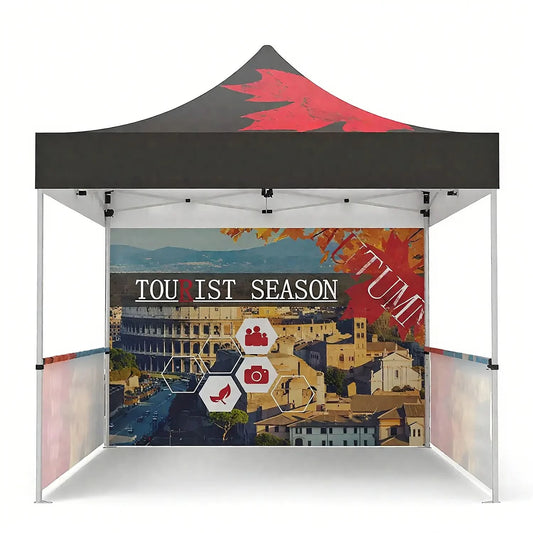
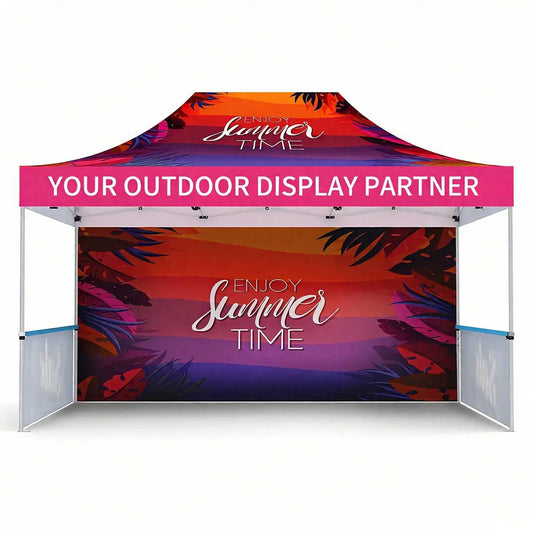
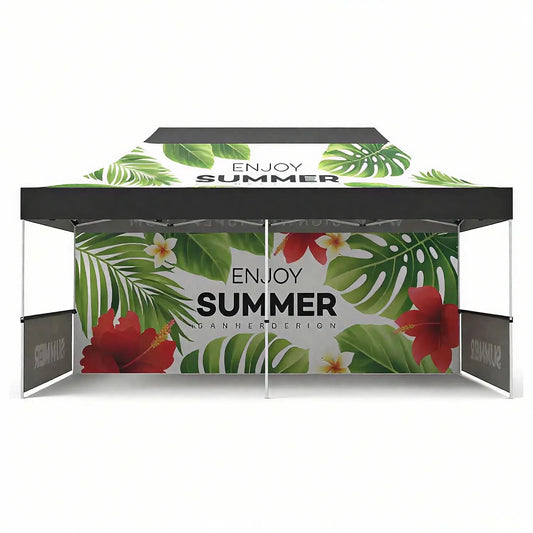
At Pyrasun, 600D PU polyester Oxford is our primary fabric choice for custom canopy tents in the US market, especially for businesses that need detailed full-color graphics, dye sublimation printing, frequent setup and takedown, and repeated commercial use. A flame-retardant version of 600D PU is also available for applications with additional fire-safety requirements.
What Fabric Is Used for Custom Canopy Tents?
Polyester is one of the most commonly used base fabrics for custom canopy tents because it provides a good combination of strength, flexibility, durability, and printability.
The terms 600D and 420D refer to the denier of the polyester yarn. In general, a higher denier indicates a heavier and more substantial base fabric, although denier alone does not determine the overall quality of a finished canopy fabric.
The coating is also important. A PU, PVC, or silver-coated finish can change the fabric's water resistance, flexibility, appearance, and performance in outdoor conditions. For this reason, choosing a canopy tent fabric should involve more than simply comparing fabric weight or denier.
600D PU Polyester Oxford
600D PU polyester Oxford combines a 600D polyester Oxford base with a flexible polyurethane (PU) coating. The result is a fabric that provides a good balance of durability, flexibility, weather resistance, and printing performance.
Why Choose 600D PU Oxford?
One of the main advantages of 600D PU Oxford is its flexibility. The fabric remains relatively soft and flexible during folding, transportation, and storage, making it suitable for businesses that repeatedly set up and take down their tents. It is particularly well suited to:
- Trade shows and exhibitions
- Brand activations
- Outdoor promotional events
- Sporting events
- Farmers markets and vendor events
- Repeated commercial use
- Portable branded displays
The fabric also provides good tensile and tear resistance for normal commercial canopy applications.
600D PU and Dye Sublimation Printing
600D PU polyester Oxford is especially suitable for dye sublimation printing, which is our primary printing method for detailed custom graphics. Dye sublimation transfers the ink into the fabric rather than leaving a thick layer of ink on the surface, making it possible to produce detailed, full-color graphics with smooth gradients and complex artwork. It is a strong choice for:
- Full-color branding
- Detailed logos
- Complex graphics
- Gradients
- Photographic images
- Large-area graphics
- Small-batch custom orders
For businesses that want a highly customized canopy tent without committing to a large production quantity, 600D PU with dye sublimation is our recommended combination. 600D PU can also be used with other printing processes depending on the artwork and production requirements.
600D PU Fire-Retardant Polyester Oxford
For applications with additional fire-safety requirements, Pyrasun also offers 600D PU fire-retardant polyester Oxford. It uses a 600D polyester Oxford base with a PU coating system containing flame-retardant additives, rather than relying on a simple surface-applied fire-retardant treatment.
The flame-retardant treatment is designed to help slow flame spread and improve the fabric's fire performance. When exposed to an open flame, the fabric can char, and the flame may self-extinguish after the ignition source is removed, depending on the tested fabric construction and applicable test conditions.
Flame retardant does not mean fireproof. Prolonged exposure to an open flame can still damage or destroy the fabric. The purpose of flame-retardant fabric is to help limit flame spread and improve fire safety, not to make the canopy fabric impossible to burn.
Compared with standard 600D PU, the flame-retardant version can maintain a similar soft and flexible hand feel while providing the additional fire-performance characteristics required for certain commercial applications. It is suitable for repeated setup, takedown, transportation, and storage.
The flame-retardant 600D PU fabric can also support dye sublimation, UV printing, and screen printing, depending on the specific fabric construction and production requirements. For projects where fire performance and printed graphics are both important, fabric and printing compatibility should be confirmed before production.
Typical applications include indoor and outdoor trade shows, shopping mall events, sporting events, large markets, and other commercial events where venue fire-safety requirements may apply.
Important: Fire-safety requirements can vary by venue, event, and local authority. If a project requires a specific standard such as CPAI-84, the actual fabric should be supported by the appropriate test report or certification documentation before it is specified for the project.
The main consideration is cost: fire-retardant 600D PU generally costs more than standard 600D PU because of the additional treatment and testing requirements.
600D PVC Polyester Oxford
600D PVC polyester Oxford uses a 600D polyester Oxford base with a PVC coating. Compared with PU-coated fabric, PVC-coated fabric is generally firmer and more structured. It also provides strong water resistance, making it a practical option for customers who prioritize a sturdy fabric and reliable protection from rain.
Benefits of 600D PVC Oxford
- Firm and structured construction
- Strong water resistance
- Good tensile and tear resistance
- Durable outdoor construction
- Competitive material cost
- Suitable for repeated assembly and use
The heavier PVC coating also gives the fabric a more substantial feel. 600D PVC can be used for both repeatedly assembled tents and applications where the tent remains in place for longer periods. However, PVC-coated fabric is generally less flexible than PU-coated fabric. It can become stiffer in cold temperatures, and repeated folding can place additional stress on the coating.
Printing on 600D PVC Oxford
600D PVC is not suitable for conventional dye sublimation printing because the high temperature required by the process can affect the PVC coating. For this reason, screen printing and UV printing are more appropriate options for PVC-coated fabric, depending on the design and production requirements. Screen printing works particularly well for simpler logos and designs with a limited number of colors.
If your priority is a sturdy, water-resistant fabric with a straightforward logo design, 600D PVC can be a practical alternative to PU.
420D Silver-Coated Polyester Oxford
420D silver-coated polyester Oxford is a lighter-weight option designed primarily for sun protection and budget-conscious applications. It uses a 420D polyester Oxford base with a PU base and silver-coated layer. The silver coating helps reflect sunlight and reduce heat buildup under the canopy.
Benefits of 420D Silver-Coated Oxford
- Lightweight construction
- Soft and flexible feel
- Enhanced sun protection
- Heat-reflective properties
- Lower material cost
- Easy handling and transportation
It can be suitable for temporary outdoor stalls, seasonal events, summer activities, and other applications where shade, portability, and affordability are important. Because the base fabric is thinner than 600D options, it generally provides lower tear and water resistance. It is therefore better suited to less demanding applications than prolonged exposure to heavy wind and rain.
Printing on 420D Silver-Coated Oxford
The silver-coated back is not intended as a normal printing surface. Printing is generally performed on the front side. Depending on the specific fabric construction and artwork, screen printing or UV printing can be considered. Sample testing is recommended before larger production when print adhesion, color accuracy, or artwork compatibility is especially important.
600D PU vs. 600D PVC vs. 420D Silver-Coated Fabric
Each fabric has a different balance of durability, flexibility, water resistance, sun protection, printing compatibility, and cost.
| Specification | 600D PU Polyester Oxford | 600D PVC Polyester Oxford | 420D Silver-Coated Polyester Oxford |
|---|---|---|---|
| Base Fabric | 600D Polyester Oxford | 600D Polyester Oxford | 420D Polyester Oxford |
| Weight | 220-240 g/m² (Standard 230gsm) | 240-270 g/m² (Standard 250gsm) | 180-210 g/m² (Standard 190gsm) |
| Water Resistance | 1500-2000mm (Standard 2000mm) | 1800-2500mm (Standard 2000mm) | 1200-1600mm (Standard 1500mm) |
| Coating | PU (Polyurethane) | PVC (Polyvinyl Chloride) | PU Base + Silver UV Coating |
| UV Protection | Standard UV resistance | Standard UV resistance | Enhanced UV protection and heat reflection |
| Hand Feel | Soft and flexible; remains relatively flexible in cooler temperatures | Firm and structured; may become stiffer in cold temperatures | Soft and lightweight |
| Tear Resistance | Excellent | Good | Fair |
| Printing Method | Dye sublimation, UV printing, and screen printing | Screen printing and UV printing; not suitable for conventional dye sublimation | Screen printing or UV printing on the front side |
| Best For | Full-color graphics, complex designs, frequent setup and takedown, and reusable promotional tents | Simple graphics, sturdy applications, repeated assembly, and cost-conscious projects | Temporary sunshade applications and budget-oriented projects |
| Key Benefits | Flexible, fold-resistant, durable, and excellent for detailed full-color printing | Strong structure, excellent water resistance, and competitive cost | Lightweight, sun-protective, and budget-friendly |
| Considerations | Higher material cost | Less flexible and more sensitive to cold temperatures and repeated folding | Thinner base fabric with lower tear and water resistance |
Fabric specifications can vary depending on the exact fabric construction, coating, and production batch. Specific projects may require sample testing before mass production. The choice of fabric should be made together with the intended printing method and artwork, since compatibility varies by coating, as noted above.
How to Choose the Right Canopy Tent Fabric
The best fabric depends on how you plan to use the tent.
Choose 600D PU if you need:
- Full-color custom graphics
- Complex artwork
- Dye sublimation printing
- Small-batch custom orders
- Frequent setup and takedown
- Repeated transportation and storage
- Reusable promotional tents
Choose Fire-Retardant 600D PU if you need:
- Additional flame-retardant performance
- Indoor or outdoor commercial event use
- Trade show or exhibition applications with venue fire-safety requirements
- Full-color custom graphics
- Dye sublimation printing
- Frequent setup and takedown
- Reusable branded tents
Fire-retardant 600D PU is a higher-cost option for projects where fire-safety requirements are an important part of the material specification. When a specific standard such as CPAI-84 is required, the applicable test report or certification should be confirmed for the actual fabric used.
Choose 600D PVC if you need:
- Strong water resistance
- A firm and structured fabric
- Screen-printed logos
- UV-printed graphics
- Repeated assembly and outdoor use
- A competitive material cost
600D PVC is a practical choice when water resistance and fabric structure are higher priorities than maximum flexibility.
Choose 420D Silver-Coated if you need:
- Enhanced sun protection
- Lightweight construction
- Temporary outdoor use
- Seasonal or summer applications
- A budget-friendly solution
This fabric is particularly suitable when shade and heat reflection are more important than maximum tear and water resistance.
For most reusable branded canopy tents, 600D PU polyester Oxford offers the best overall balance of durability, flexibility, printability, and handling. Fire-retardant 600D PU is the upgraded choice when additional fire-safety performance is required. 600D PVC and 420D silver-coated polyester remain useful alternatives when specific requirements such as fabric structure, water resistance, lightweight construction, sun protection, or material cost take priority.
Choosing the right combination of fabric, coating, and printing method helps ensure that your custom canopy tent is suited to its intended use, appearance, and operating conditions.
Get a Free Custom Canopy Tent Design & Quote
Share your logo and project details. Get a free 3D design preview and a personalized quote for your branded canopy tent.