




Custom Pop Up Tents: A Complete Buying Guide for Businesses

For businesses buying their first custom pop up tent, it's easy to get pulled into comparing sizes, frame materials, or printing techniques before answering a more basic question: what should a business actually look for when buying a tent for repeated use? This guide steps back from those specifics to answer that question — what to look for, what to compare between suppliers, and what mistakes to avoid before you order.
What Are Custom Pop Up Tents?
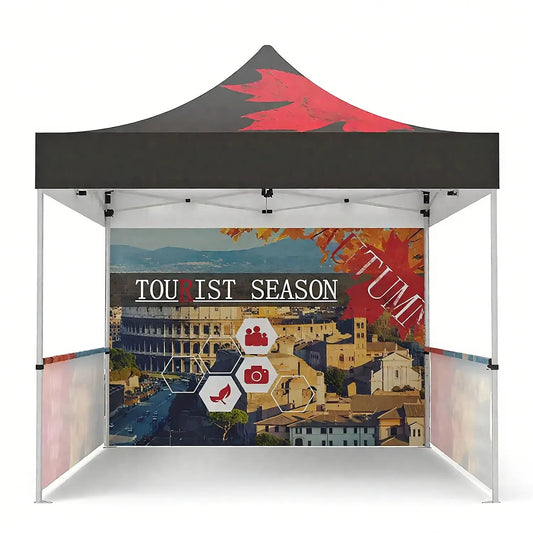
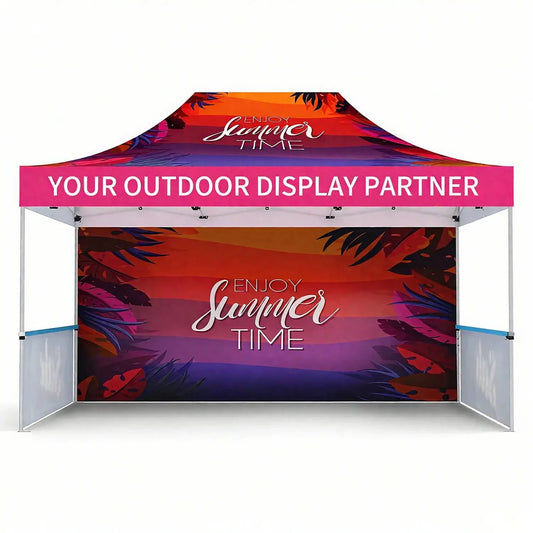
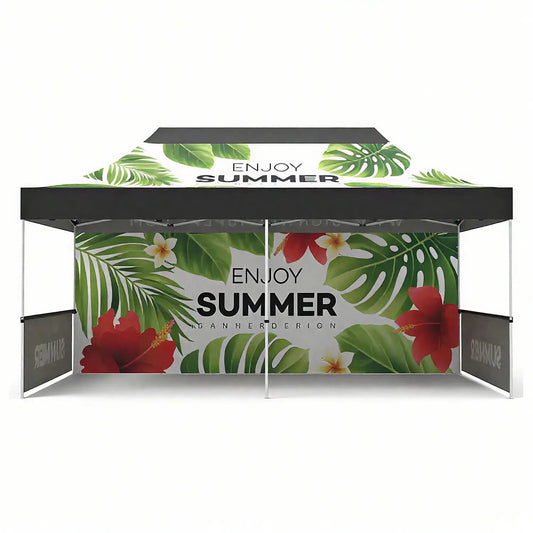
Custom tents for business are built exactly this way — a folding frame canopy that collapses down into a carry bag, paired with a fabric top printed with your own logo, colors, and branding rather than sold as a plain, generic canopy.
The difference between "custom" and "standard" comes down to that print: a standard pop up tent is typically a stock color with no branding, while a custom one is built to order with your artwork on the canopy, valance, or walls. For businesses, that distinction matters because the tent doubles as a piece of branded real estate every time it's set up — not just shelter, but a visible extension of the business at every event it attends.
Why Businesses Choose Custom Pop Up Tents
Build a Consistent Brand Presence
A tent printed with the same logo, colors, and messaging every time gives a business a recognizable presence wherever it sets up, rather than starting from scratch with signage at every new venue.
Create a Professional Event Space
A branded, well-built tent gives a booth a finished, intentional look, which signals to both staff and attendees that the business takes its presence seriously.
Set Up and Pack Down Quickly
A folding pop-up design is built to go from packed to fully set up in minutes, which matters for businesses running the same setup at event after event throughout a season.
Reuse the Tent Across Multiple Events
Because it packs down and travels, one tent typically covers a business's entire event calendar rather than being built for a single occasion.
What Makes a Custom Pop Up Tent Commercial-Grade?
Plenty of tents look similar in a product photo. What actually separates a commercial-grade tent from a one-time-use canopy comes down to a handful of construction details that aren't always visible at a glance:
- Frame construction — tube wall thickness, profile shape, and connector design matter more than the material name alone. A frame built for repeated commercial use is designed to withstand repeated setup-and-teardown cycles, not a handful.
- Fabric quality — a heavier-weight, properly coated fabric holds color, resists tearing, and sheds water better than a lightweight fabric built for occasional use.
- Printing quality — a print method suited to the artwork and the fabric keeps colors accurate and resistant to fading, rather than cracking or dulling after a season outdoors.
- Hardware and connectors — the pins, buttons, and joints that hold the frame together are usually the first thing to wear out; quality hardware is built to withstand repeated use rather than being an afterthought.
- Reinforced stress points — the corners, joints, and attachment points that take the most physical stress during setup and in wind should be reinforced rather than built to the same spec as the rest of the frame.
- Replacement parts — a commercial-grade tent is designed so individual components (a leg, a connector, a canopy top) can be replaced on their own, rather than requiring a full tent replacement over a single damaged part.
- Warranty — a supplier willing to stand behind individual components with a real warranty is a reasonable signal that they expect the tent to hold up.
None of these show up clearly in a product photo, which is exactly why they're worth asking about directly before you order.
What to Consider When Buying a Custom Pop Up Tent
Choose the Right Tent Size
Tent size should match your display needs, expected staff, and the space available at your typical events. A 10x10 typically suits a compact single-table booth, a 10x15 gives more room for additional displays or staff, and a 10x20 supports multiple activity zones for larger, multi-function setups.
Choose the Right Frame
The steel vs aluminum decision generally comes down to trade-offs in weight, cost, and portability, and depends on how often you'll transport and set up the tent and how much that weight difference matters for your team.
Consider Canopy Fabric Quality
Fabric affects durability, weather resistance, and how well your printed colors hold up over time. Ask about fabric weight, water resistance, and UV resistance rather than judging quality from a photo alone.
Choose the Right Printing Method
Printing methods vary in how well they handle full-color artwork versus simpler logos, and coverage can range from a single panel to the entire canopy. The right method depends on your artwork and how much of the tent you want branded.
Check Setup, Transport, and Storage
Consider how the frame folds, how much it weighs when packed, and how much storage space the carry bag needs — these matter more the more frequently you plan to use the tent.
Consider Accessories and Add-Ons
Common add-ons include sidewalls, half walls, flags, tables or counters, weights, and carry bags. Plan these together with the tent itself rather than adding them as an afterthought, since they affect how the finished setup actually functions at an event.
How to Choose a Custom Pop Up Tent for Your Business
Different event types tend to put different demands on a tent — some prioritize a polished appearance and quick setup, others prioritize wind and weather resistance, and others prioritize how well the tent holds up to frequent, repeated use. Rather than one tent being universally "best," the right choice usually comes down to which of those factors matters most for how your business actually uses it.
| Use Case | What to Prioritize |
|---|---|
| Trade shows | Quick setup, polished appearance, easy transport between venues |
| Brand activations | Full-color, high-visibility printing and a flexible accessory setup |
| Outdoor promotions | Weather resistance and a sturdy frame for exposed conditions |
| Sports and community events | Durability and quick setup for repeated use across a season |
| Frequent or rental use | Commercial-grade construction and available replacement parts |
Common Mistakes When Buying Custom Pop Up Tents
Choosing Based Only on Price
The lowest quote doesn't always reflect the same frame, fabric, or printing quality as a higher one — compare full specifications, not just the total cost.
Ignoring Frame Quality
Two tents can look identical in a photo while using very different tube thickness, connectors, and construction — always ask for the actual specifications.
Choosing the Wrong Size
A size that looks fine on paper can feel cramped once tables, displays, and staff are actually in place — plan the layout before you order, not after.
Overlooking Transport and Storage
A tent that's difficult to carry or store becomes a recurring hassle at every event, especially for businesses attending several events a year.
Not Checking What Is Included
Confirm upfront whether accessories, a carry bag, and printing are included in the quoted price, or added separately — assumptions here lead to surprises at checkout.
Choosing a Supplier Without Clear Specifications
A supplier who can't answer specific questions about frame material, wall thickness, or fabric weight is harder to hold accountable if something doesn't hold up.
Custom Pop Up Tent Buying Checklist
| What to Check | What to Ask |
|---|---|
| Size | Does this size fit my actual layout and display needs? |
| Frame | What material, wall thickness, and connectors are used? |
| Fabric | What weight, coating, and weather resistance does it have? |
| Printing | Which method is used, and how much of the tent is branded? |
| Accessories | What's included, and what's available as an add-on? |
| Shipping | What are the delivery options and expected timelines? |
| Production time | How long from order to delivery? |
| Warranty | What's covered, and for how long? |
| Replacement parts | Can individual components be replaced later? |
| Artwork approval | Do I get to review a design before production begins? |
Frequently Asked Questions
What should I look for in a custom pop up tent?
Frame construction, fabric quality, printing method, available accessories, and what's included in the price are the main things to compare between suppliers, rather than judging by appearance or price alone.
How long does a custom pop up tent last?
A well-built custom pop up tent can last for many years with proper use and maintenance. Actual lifespan depends heavily on frame quality, fabric, climate, and how often it's used and packed down.
Can custom pop up tents be used outdoors?
Yes, that's their primary use case — most are built with weather-resistant fabric and a frame designed for outdoor setup, though performance varies by construction quality.
Are custom pop up tents easy to set up?
Generally yes — the folding frame design is built for quick assembly, often by one or two people, though larger sizes may require more hands and more time.
Can I order custom pop up tents in bulk?
Yes, most suppliers support bulk and wholesale orders, often with volume pricing and adjusted production timelines for larger quantities.
Get Free Design & Quote for Your Custom Canopy Tent
Free artwork review and professional support to visualize your branded tent before production.
Get Free Design & Quote → View Custom Tent Options →