




Custom Food Tent Guide for Vendors, Markets, and Outdoor Events

Food vendors put different demands on a canopy tent than a typical branded display booth does — grease and spills during service, hours of direct sun over a serving counter, and a wall setup built for handing food to customers rather than pure product display. This guide covers what to look for in a tent built for food vendor use specifically: fabric, wall configuration, size, and frame, rather than repeating the general buying advice that applies to any custom canopy tent.
What to Look For in a Food Vendor Tent
A tent built around branding and product display has different priorities than one built for actually serving food day after day. A few things worth prioritizing specifically for food vendor use:
- Fire-retardant fabric as an option. Some venues and events require fire-retardant fabric documentation, so it's worth checking whether your supplier offers this as an option and can provide certification if asked.
- A wall configuration built for service, not just display. Food vendors typically need a setup that supports handing food across a counter to customers, rather than a wall built purely for branding visibility.
Wall Configuration for Food Service
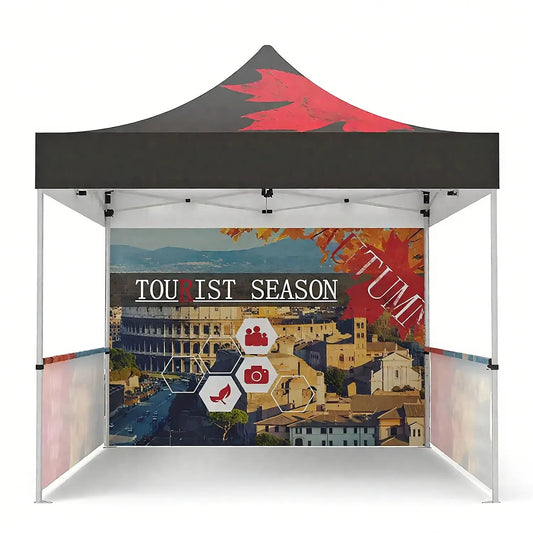
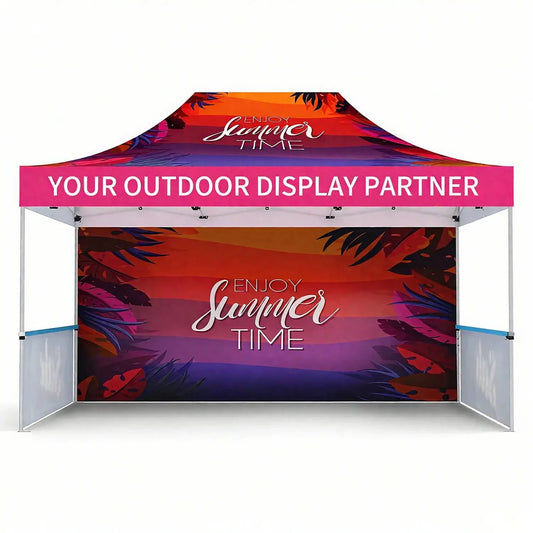
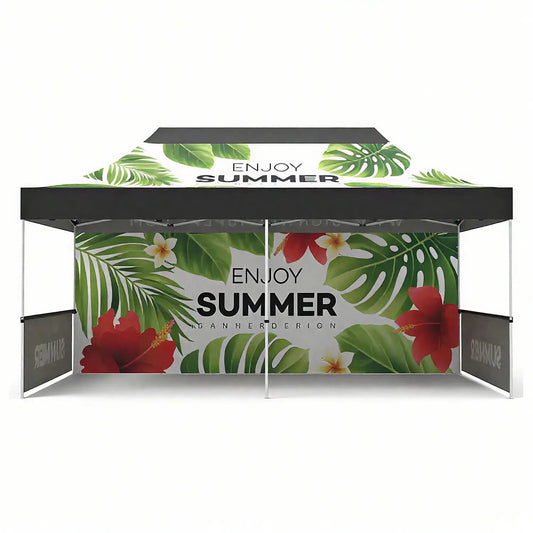
Wall configuration for a food vendor tends to be a functional choice first and a branding choice second. A half-height counter wall lets staff serve customers at a comfortable height while still giving the booth a defined front edge. A full back wall gives the setup a clean backdrop and shields the working area from view, while sidewalls add coverage on the sides where a full-height wall isn't needed for serving.
The right combination depends on your setup — a simple beverage stand has different wall needs than a booth with a longer counter and more staff working the line.
Fabric Considerations for Food Vendors
Pyrasun food tents use 600D polyester fabric as standard, the same durable, weather-resistant fabric used across our canopy tent range. If fire-retardant fabric is relevant for your venue, confirm it's available as an option and ask for documentation upfront rather than after you've already ordered.
Choosing the Right Size for a Food Vendor Booth
Food vendor setups often need to fit a serving counter, prep space, and storage for supplies under one canopy — more functions than a typical single-table display booth.
| Size | Typical Setup | Common Use |
|---|---|---|
| 10x10 | Compact serving and display setup | Farmers markets and smaller food booths |
| 10x15 | Additional room for serving and preparation | Food vendors needing more working space |
| 10x20 | Larger multi-area setup | Vendors needing separate serving, preparation, or storage areas |
See our size guides for 10x10, 10x15, and 10x20 for a more detailed breakdown of each footprint.
Frame Considerations for Food Vendor Use
The general frame considerations that apply to any custom canopy tent apply here too — see our steel vs aluminum comparison for the full breakdown. Food vendors who use their tents frequently should also pay attention to frame durability and corrosion resistance, particularly when the tent is regularly exposed to outdoor moisture.
Printing for Food Vendor Visibility
At a market or festival, foot traffic often approaches from the side rather than head-on, which makes side valance and sidewall printing particularly useful for food vendors — a logo or menu item visible from the side can catch attention before a customer is directly in front of the booth. Dye-sublimation printing works well for full-color menu graphics or photos, while screen printing is a simpler, lower-cost option for a straightforward logo.
Common Event Types for Custom Food Tents
Custom food tents show up across a range of settings: farmers markets, food festivals, outdoor catering events, coffee and beverage stands, and carnival or fairground food booths. Food vendors, mobile food businesses, and outdoor catering operators all tend to share the same core needs from the tent itself — a functional serving setup and a structure that holds up to repeated use across a season of events.
Common Mistakes When Choosing a Food Vendor Tent
Choosing a Display Tent Instead of a Service-Ready Setup
A tent built for branding and display doesn't always support a functional service counter — confirm your wall configuration actually works for handing food to customers before you order.
Not Asking About Fire-Retardant Fabric Options
Skipping this question until an event organizer asks for documentation can mean scrambling to find a supplier who offers it at the last minute — ask upfront if your venue might require it.
Overlooking Frame Durability for Frequent Use
A booth used week after week in outdoor conditions puts more cumulative wear on a frame than an occasional display setup — it's worth asking how the frame holds up to that kind of frequent, regular use.
Setup and Maintenance
A few practical habits go a long way toward keeping a food vendor tent looking sharp and functioning well across a season of regular use:
- Set up with more than one person. Forcing a frame open or closed under pressure is a common way to bend or damage tubing — take the time to align the frame properly rather than rushing the setup.
- Let the fabric dry before packing it away. Folding and storing a canopy top while it's still damp is one of the most common causes of mildew and odor.
- Store the tent somewhere dry and ventilated. Avoid long-term storage in direct sunlight, which can accelerate wear on both the fabric and its coating.
Custom Food Tent Buying Checklist
| What to Check | What to Ask |
|---|---|
| Wall configuration | Does the setup support a functional service counter? |
| Fabric | Is a fire-retardant option available? |
| Documentation | Can the supplier provide fire-retardant certification if my venue asks? |
| Frame | How does it hold up to repeated steam and moisture exposure? |
| Printing | Is side valance and sidewall printing included? |
| Size | Does the footprint fit my counter, prep space, and storage needs? |
Frequently Asked Questions
Do food vendor tents come with fire-retardant fabric?
It depends on the supplier — fire-retardant fabric is available as an option from many manufacturers, but it isn't always the standard fabric. If your venue may require documentation, ask upfront whether it's offered and whether certification is provided.
Can I add a service counter to a custom food tent?
Yes. A half-height counter wall is a common configuration for food vendors, allowing staff to serve customers at a comfortable height while keeping the working area behind it separated from the customer line.
What size tent do food vendors typically need?
It depends on your setup — a serving counter, prep space, and storage often take up more room than a single display table, so plan your layout first. See our size guides for 10x10, 10x15, and 10x20 for a detailed comparison.
Are custom food tents suitable for mobile food businesses?
Yes. Food vendors, mobile food businesses, and outdoor catering operators commonly use custom food tents as a portable, branded setup that travels between markets, festivals, and catering events.
Get Free Design & Quote for Your Food Vendor Tent
Need service‑ready wall layouts or fire‑retardant certification? Get free artwork review and professional support before production.
Get Free Design & Quote → View Custom Tent Options →