




10x20 Custom Canopy Tent Buying Guide

A 10x20 custom canopy tent provides approximately 200 square feet of covered space — roughly double the area of a 10x10 and one-third more than a 10x15. It's suited to businesses that need genuinely separate functional zones under one canopy, not just more room for the same single setup.
The frame, fabric, and printing considerations that apply to any custom canopy tent apply here too — we cover those in our 10x10 Custom Canopy Tent Buying Guide. If you're deciding between 10x15 and 10x20, our Canopy Tent Size Comparison Guide can help you determine whether you actually need the larger footprint.
This guide focuses on what's specific to the 10x20: whether it's the right size for your event, how to plan multiple activity zones, and the structural and anchoring considerations that become increasingly important as the canopy gets larger.
Is 10x20 the Right Size for Your Event?
A 10x20 canopy provides approximately 200 square feet of covered space — enough for multiple distinct activity areas, a larger team, sponsor or partner branding alongside your own, or equipment and displays that simply won't fit comfortably under a 10x15.
When 10x20 Makes More Sense Than 10x15
A 10x20 tends to be the right choice when you need more than one genuinely separate zone under the canopy — a display area, a demonstration area, and a storage or staff area, for example — rather than just extra room for the same single function.
It's also worth considering for teams with several staff members working simultaneously, sponsor or co-branded setups where more than one organization needs visible space, and multi-day events where you want a more complete, self-contained setup rather than a compact booth.
If your list of activities under one tent includes several distinct functions that need to operate at the same time, a 10x20 may provide the space and flexibility you need.
However, a larger canopy is not automatically the better choice. If you only need one product display and a small customer interaction area, a 10x15 may be sufficient.
Always confirm your event's permitted booth or footprint size before ordering. Some venues cap dimensions well below 10x20, regardless of how much space you'd prefer.
Planning Multiple Activity Zones
At 200 square feet, a 10x20 canopy can genuinely support two or three distinct zones rather than one larger version of a single-purpose booth. The key is to organize the available space around the activities that need to happen under the tent.
Here are four common ways businesses divide the space:
1. Display, Demonstration, and Storage
Use the front area for products and branding, reserve another section for demonstrations or sampling, and keep inventory and staff supplies toward the back. This arrangement works well for businesses that need to display products while also providing hands-on demonstrations.
2. Multiple Staff Stations
Separate working areas can allow two or three staff members to handle customer conversations, transactions, product demonstrations, or registrations without crowding each other. This can be useful at busy promotional events, trade shows, and community activities.
3. Co-Branded or Sponsor Space
A 10x20 can accommodate a primary brand display alongside a separate area for a sponsor, partner, or supporting organization. Each side can have its own signage and display materials while remaining part of one coordinated booth.
This arrangement is particularly useful for sports events, community activities, brand collaborations, and sponsored promotions.
4. Hospitality Plus Retail
Businesses can use one side for seating, refreshments, or customer conversations while keeping the other side available for merchandise and product displays. This combination can work well for events where visitors need both an interaction area and a place to browse products.
Plan Traffic Flow Between Zones
Planning what goes where is only part of the process. You also need to consider how customers and staff will move between different areas.
Before ordering, consider the following:
- Customer entry: Where will visitors enter the canopy, and can they easily access the main display?
- Movement between zones: Is there enough space for visitors to move between product displays, demonstrations, and other activities?
- Staff access: Can employees move between working areas without disrupting customer interactions?
- Storage access: Can staff reach supplies and inventory without blocking the main display?
- Clear pathways: Does the layout leave enough room for people to enter, browse, and exit comfortably?
As with any size, sketch the layout before you order. At 10x20, it's worth planning not just what goes where, but how people will move between zones. A poorly planned 10x20 can end up feeling like three cramped booths rather than one spacious setup.
Wind, Anchoring, and Structural Considerations
A larger canopy has more exposed fabric surface area, making wind exposure and anchoring important considerations at 10x20. Frame selection, setup conditions, and proper anchoring all contribute to how well the canopy performs during outdoor events.
A few things are worth planning for specifically at this size:
Ballast and Anchoring Matter More
The larger the canopy surface, the more wind load the structure can experience. Appropriate weights or stakes are therefore an important part of the setup, not just an optional accessory.
The correct anchoring method depends on the surface, event conditions, and manufacturer's recommendations. Grass, concrete, asphalt, and other surfaces may require different anchoring solutions.
Before your event, confirm the recommended anchoring method for your specific canopy and follow the venue's safety requirements. Never assume that a heavier frame eliminates the need for proper anchoring.
Frame Choice Becomes More Important
The differences between steel and aluminum — including weight, wall thickness, and frame construction — apply at every canopy size. At 10x20, however, it's particularly important to compare the complete frame specifications rather than choosing based on material alone.
Consider tube dimensions, wall thickness, joints, connectors, frame design, transportation requirements, and how frequently you plan to use the canopy.
A well-matched frame configuration should support your intended usage while remaining practical to transport, assemble, and maintain. For businesses planning frequent outdoor events, durability and replacement-part availability are also important considerations.
It's also worth considering the difference between using one continuous 10x20 canopy and placing two 10x10 canopies side by side. Both arrangements can provide approximately 200 square feet of combined footprint, but a single 10x20 canopy provides one continuous covered area without the gap between two separate tops.
Plan for a Two-Person Setup
A 10x20 canopy has a larger frame and fabric top than smaller configurations. Although setup requirements vary by frame design and individual experience, having two people available is recommended to make positioning, unfolding, and securing the canopy easier.
Before opening the frame completely, check that the legs and connecting components are properly aligned. Avoid forcing joints or connectors, and follow the manufacturer's assembly instructions.
Allow additional time for setup, especially if you're also installing sidewalls, weights, signage, and display equipment.
Wind conditions should always be considered before and during an outdoor event. Follow the manufacturer's operating recommendations and take down the canopy when weather conditions become unsafe.
Wall Configuration at 10x20
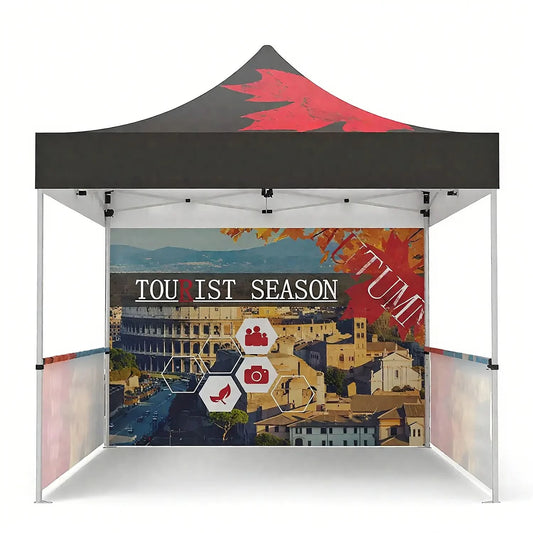
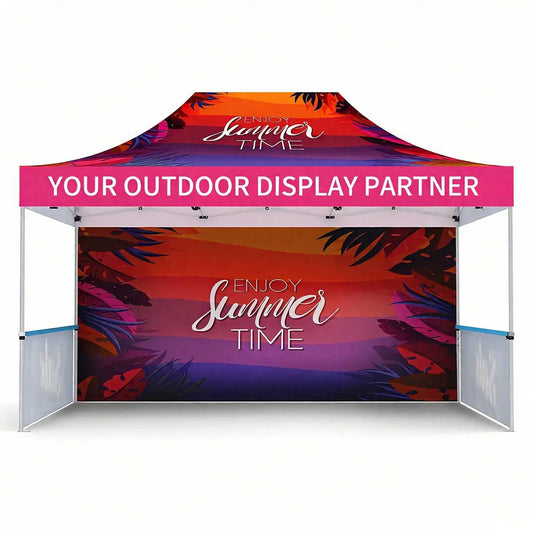
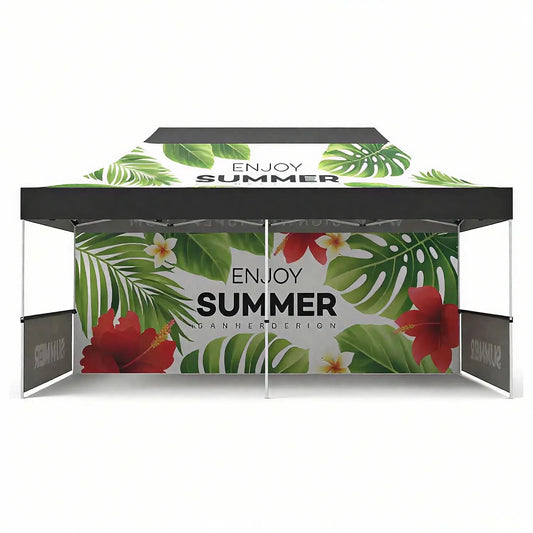
The same three wall configurations are available for a 10x20 canopy: 1 full back wall, 1 full back wall plus 2 half sidewalls, or 3 full sidewalls. At 200 square feet, the choice affects how open or enclosed the overall display feels and how much additional branding space is available.
1 Full Back Wall
A single full back wall provides a large branding backdrop while keeping the front and sides open. This configuration works well for businesses that want customers to approach from multiple directions and browse products across the full width of the canopy.
It is a practical option for open retail displays, product demonstrations, and promotional booths.
1 Full Back Wall + 2 Half Sidewalls
This configuration adds partial side coverage while maintaining an open feel. The back wall provides the main branding area, while the half sidewalls help define the booth without completely enclosing it.
It can work well for businesses that want additional side branding and some separation from surrounding event spaces while maintaining visibility and customer access.
3 Full Sidewalls
Three full sidewalls create a more enclosed display while keeping the front open for customer access. This configuration provides additional branding surfaces, greater privacy for products or equipment, and more coverage from the sides.
It can be useful for businesses that need a more defined event space or want to create a dedicated branded environment.
Which Wall Configuration Should You Choose?
| Wall Configuration | Best For |
|---|---|
| 1 Full Back Wall | Open displays, customer access, and a large branded backdrop. |
| 1 Full Back Wall + 2 Half Sidewalls | Partial side coverage with an open display environment. |
| 3 Full Sidewalls | More branding surfaces, privacy, and a more enclosed display. |
Keep in mind that sidewalls are attached to the outside of the canopy frame. They do not create separate internal rooms. If you want to divide your 10x20 into different activity zones, plan the arrangement using tables, display counters, furniture, and equipment.
Frame, Fabric, and Printing
The same core product considerations apply to a 10x20 as to other Pyrasun canopy tents: frame material and wall thickness, fabric construction, coating, and printing method. Pyrasun offers four frame configurations — Foundation, Pro, Premium, and Elite — along with 600D polyester fabric with PU or PVC coating and custom printing options.
All four frame configurations are available for 10x20 canopies. The right choice depends on your budget, transportation requirements, expected frequency of use, and the frame specifications that best match your application.
For the complete breakdown of frame construction, fabric specifications, and printing methods, see our 10x10 Custom Canopy Tent Buying Guide.
You can also read our Steel vs Aluminum Canopy Tent Frame Comparison for a detailed explanation of frame material, weight, construction, and durability considerations.
These technical specifications apply across canopy sizes. What changes at 10x20 is how the larger structure affects your setup, anchoring, transportation, and event layout.
10x20 Buying Checklist
Before ordering a 10x20 canopy, review the following points to make sure your planned setup matches your event requirements.
| What to Check | What to Ask |
|---|---|
| Zone Planning | Have I sketched a layout with each zone's function clearly defined? |
| Event Footprint | Does my venue permit a 10x20 booth? |
| Traffic Flow | Can customers and staff move comfortably between different activity areas? |
| Anchoring and Ballast | What anchoring or ballast does the manufacturer recommend for this size and surface? |
| Crew and Setup Time | Do I have enough people and time to assemble the canopy and install its accessories? |
| Wall Configuration | Does my layout call for an open display, partial side coverage, or three full sidewalls? |
| Frame, Fabric, and Printing | Have I compared the available frame, fabric, and printing specifications? |
| Transportation and Storage | Can I transport and store the complete canopy system and its accessories? |
For more detailed questions about frame materials, fabric, and printing specifications, refer to our 10x10 Custom Canopy Tent Buying Guide.
Frequently Asked Questions
Is a 10x20 canopy better than a 10x15?
Neither is universally better. A 10x15 usually fits businesses needing additional room for a larger display or one extra activity area, while a 10x20 provides approximately 200 square feet for multiple distinct zones, a larger team, or co-branded displays. The number of activities you need to accommodate should guide your decision.
Is a 10x20 canopy tent harder to set up?
A 10x20 generally requires more space and coordination during setup than a 10x10 or 10x15. Having two people available is recommended to make positioning and assembling the larger frame easier. Allow additional time if you're also installing sidewalls, weights, and display equipment.
Does a 10x20 canopy need extra anchoring in wind?
A 10x20 has a larger exposed surface area than smaller canopy sizes, making appropriate anchoring especially important. The correct ballast or anchoring method depends on the surface, weather conditions, and manufacturer recommendations. Always follow the specified setup and anchoring instructions, and take down the canopy when conditions become unsafe.
Is a 10x20 canopy tent big enough for a sponsor or large activation?
For many sponsor booths, multi-zone activations, and larger team setups, yes. Its approximately 200 square feet of covered space can accommodate a primary brand display alongside a separate demonstration, hospitality, or partner area. Always confirm your event's permitted footprint before ordering, since requirements vary by venue.
What frame, fabric, and printing options are available for a 10x20?
Pyrasun offers four frame configurations: Foundation, Pro, Premium, and Elite. The canopy fabric is 600D polyester with PU or PVC coating, and available printing options include dye-sublimation and screen printing. The best configuration depends on your intended use, transportation needs, and customization requirements. See our 10x10 Custom Canopy Tent Buying Guide for a detailed explanation of these options.
Final Thoughts
A 10x20 custom canopy tent makes sense when you have multiple distinct functions to fit under one structure — not simply because it's the largest option available. Its approximately 200 square feet of covered space can accommodate product displays, demonstrations, staff stations, sponsor branding, and storage within one organized setup.
Plan your activity zones and traffic flow first, confirm your event's permitted footprint, and consider anchoring and setup requirements given the larger structure. Then compare the available frame, fabric, and printing options to find a configuration that matches your business needs.
Get a Free Custom Canopy Tent Design & Quote
Share your logo and project details. Get a free 3D design preview and a personalized quote for your branded canopy tent.