




10x20 Custom Canopy Tent Buying Guide

A 10x20 custom canopy tent is the largest standard size in our lineup — around 200 square feet of covered space, roughly double a 10x10 and a third larger than a 10x15. It's suited to businesses that need genuinely separate functional zones under one canopy, not just more room for the same single setup.
The frame, fabric, and printing considerations that apply to any custom canopy tent apply here too — we cover those in full in our 10x10 Custom Canopy Tent Buying Guide. If you're deciding between 10x15 and 10x20, our 10x15 Custom Canopy Tent Buying Guide can help you determine whether you actually need the larger footprint. This guide focuses on what's specific to the 10x20: whether it's actually the size you need, how to plan multiple activity zones, and the structural considerations that become more important as the canopy gets larger.
Is 10x20 the Right Size for Your Event?
A 10x20 canopy provides approximately 200 square feet of covered space — enough for multiple distinct activity areas, a larger team, sponsor or partner branding alongside your own, or equipment and displays that simply won't fit under a 10x15.
10x10 vs. 10x15 vs. 10x20
| Size | Covered Area | Typical Use |
|---|---|---|
| 10x10 | 100 sq. ft. | Compact displays and single-booth setups |
| 10x15 | 150 sq. ft. | Larger displays, additional products, and more working space |
| 10x20 | 200 sq. ft. | Large displays, multiple activity areas, and expanded booths |
When 10x20 Makes More Sense Than 10x15
A 10x20 tends to be the right call when you need more than one genuinely separate zone under the canopy — a display area plus a demo area plus a storage or staff area, for example — rather than just extra room for the same single function. It's also common for teams of three or more staff working simultaneously, for sponsor or co-branded setups where more than one organization needs visible space, and for multi-day events where you want a more complete, self-contained setup rather than a compact booth. If your list of "things that need to happen under this tent" runs to three or more distinct activities, that's usually a sign you've outgrown 10x15.
Always confirm your event's permitted booth or footprint size before ordering — some venues cap dimensions well below 10x20, regardless of how much space you'd prefer.
Planning Multiple Activity Zones
At 200 square feet, a 10x20 canopy can genuinely support two or three distinct zones rather than one larger version of a single-purpose booth. Common ways businesses divide the space:
- Display, demo, and storage — a front zone for products and branding, a middle zone for demonstrations or sampling, and a back zone for inventory and staff prep.
- Multiple staff stations — separate areas so two or three staff members can each run a conversation, transaction, or sign-up without crowding each other.
- Co-branded or sponsor space — a primary brand zone alongside a secondary area for a partner or sponsor, common at sports and community events.
- Hospitality plus retail — a seating or refreshment area on one side, a product or merchandise area on the other.
As with any size, sketch the layout before you order. At 10x20, it's worth planning not just what goes where, but how people will move between zones — a poorly planned 10x20 can end up feeling like three cramped booths rather than one spacious one.
Wind, Anchoring, and Structural Considerations
A larger canopy catches more wind, which makes anchoring and frame choice more consequential at 10x20 than at smaller sizes. A few things worth planning for specifically at this size:
- Ballast and anchoring matter more. The larger the canopy surface, the more wind load it carries, so appropriate weights or stakes become more important, not just a nice-to-have.
- Frame choice has more riding on it. The trade-offs between steel and aluminum — weight, rigidity, wall thickness — apply at every size, but at 10x20 the consequences of an under-built frame show up faster, since there's more fabric and more surface area putting stress on the structure. A larger canopy is also simply more prone to wear and damage over repeated use, which is why a sturdier aluminum frame is generally the better choice at this size for anyone planning to use the tent long-term rather than occasionally. (Worth noting: two 10x10 canopies placed side by side cover roughly the same footprint as a 10x20, but a single continuous 10x20 top avoids the gap between them.)
- Setup takes more people and more time. A 10x20 generally isn't a one-person job — plan for a larger crew and more setup time than you'd budget for a 10x10 or 10x15.
Wall Configuration at 10x20
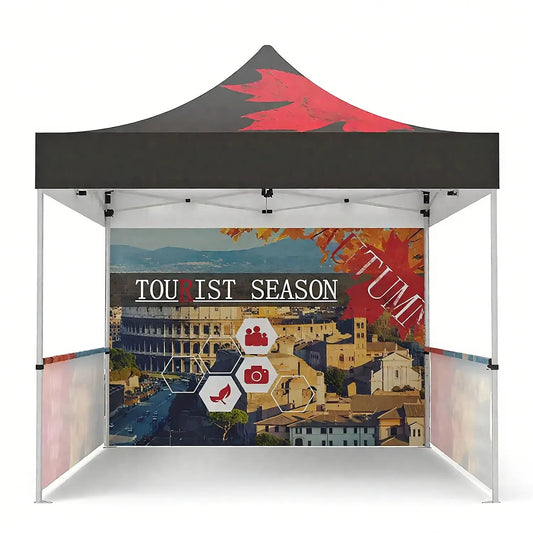
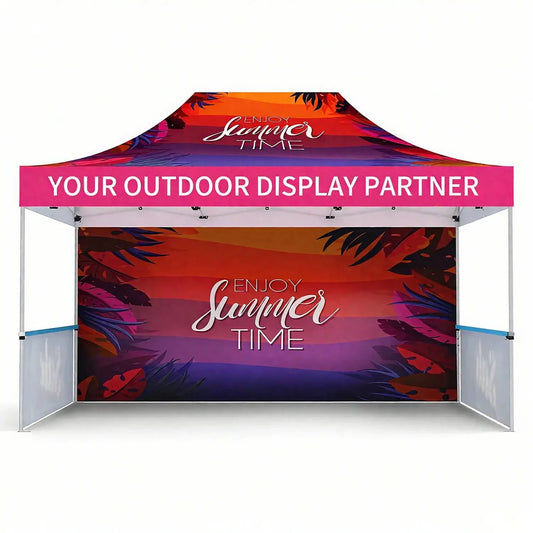
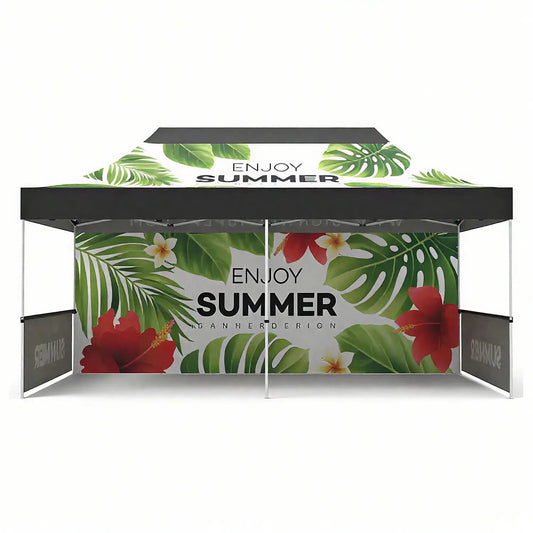
The same three wall configurations apply — 1 full back wall, 1 full back wall plus 2 half sidewalls, or 3 full sidewalls — but at 200 square feet, they're also a tool for separating your zones from each other, not just from the outside environment. A back-wall-only setup can work well if you want an open, browsable layout across the full width. Adding the two half sidewalls creates a more defined space while still leaving the upper portion open for airflow and visibility, which some businesses use deliberately to separate a semi-private demo or hospitality zone from the open retail or display side of the same tent.
Frame, Fabric, and Printing
The same core considerations apply to a 10x20 as to any Pyrasun canopy tent: frame material and wall thickness (steel vs. aluminum, and why wall thickness matters more than the material name), fabric (600D polyester with PU or PVC coating), and printing method (dye-sublimation for full-color and photographic graphics, screen printing for simpler designs). All four frame configurations — Foundation, Pro, Premium, and Elite — are available at 10x20. Given the size and the wind and durability considerations above, a sturdy aluminum frame (Premium or Elite) is generally the better choice at this size for businesses planning long-term, repeated use, rather than defaulting to the lowest-cost steel tier.
For the complete breakdown of frame construction, fabric specification, and printing methods, see our 10x10 Custom Canopy Tent Buying Guide, and our Steel vs Aluminum Canopy Tent Frame comparison guide for a full side-by-side on frame material.
10x20 Buying Checklist
| What to Check | What to Ask |
|---|---|
| Zone planning | Have I sketched a layout with each zone's function defined? |
| Event footprint | Does my venue permit a 10x20 booth? |
| Anchoring & ballast | What ballast or anchoring does the supplier recommend for this size? |
| Crew & setup time | How many people and how much time does setup typically take? |
| Wall configuration | Does my layout call for open zones, separated zones, or both? |
| Frame, fabric & printing | See the 10x10 buying guide checklist for the full supplier questions |
Frequently Asked Questions
Is a 10x20 canopy better than a 10x15?
Neither is universally better. A 10x15 usually fits businesses needing one extra zone beyond a compact booth, while a 10x20 fits businesses needing two or more genuinely separate zones, a larger team, or co-branded space. The number of distinct functions you need under the tent should decide it.
Is a 10x20 canopy tent harder to set up?
It generally takes more people and more time than a 10x10 or 10x15. Plan for a larger crew, and confirm setup expectations with your supplier before the event.
Does a 10x20 canopy need extra anchoring in wind?
Its larger surface area catches more wind than smaller sizes, so appropriate ballast or anchoring is more important, not optional. Ask your supplier for their specific recommendation for this size and your typical event conditions.
Is a 10x20 canopy tent big enough for a sponsor or large activation?
For many sponsor booths, multi-zone activations, or larger team setups, yes. Always confirm your event's permitted footprint before ordering, since requirements vary by venue.
What frame, fabric, and printing options are available for a 10x20?
The same options as our other sizes: four frame configurations (Foundation, Pro, Premium, Elite), 600D polyester fabric in PU or PVC coating, and dye-sublimation or screen printing. See our 10x10 buying guide for the full comparison of each.
Final Thoughts
A 10x20 custom canopy tent makes sense when you have multiple distinct functions to fit under one structure — not simply as the largest option available. Plan your zones first, factor in anchoring and crew size given the larger footprint, then compare frame, fabric, and printing using our 10x10 buying guide, since those decisions don't change with size.